Miraculous Medals History

Saint Catherine Laboure, is famed as a Marian visionary whom the Blessed Mary entrusted to create the Miraculous Medal, a religious pendant worn throughout the world. Catherine Laboure was born Zoe Laboure in 1808 as the ninth child of eleven to Madeleine Gontard, who later died, orphaning Catherine at the age of 9. After her mother's funeral the intuitive Catherine is rumoured to have confided in a statue of the Virgin Mary, of whom she was very fond, now I shall look to you as mother. She became a member of the nursing order which had been founded by Saint Vincent de Paul, where her faith continued to grow and flourish.

The first apparition of the Blessed Virgin Mary occurred on the eve of the feast of St Vincent. On that day, the 19th July 1830, Catherine had prayed to St Vincent that she might see the Mother of God with her own eyes. That night a child came to awake her, beckoning her to the chapel. The chapel was alight as though for Mass, and as Catherine knelt at the Communion rail a figure appeared to her. There, sat in a chair like Saint Anne's sat the Blessed Virgin Mary.

God wishes to charge you with a mission. Said the Virgin. You will be contradicted, but do not fear; you will have the grace. Tell your spiritual director all that passes within you. Times are evil in France and in the world. Come to the foot of the altar. Graces will be shed on all, great and little, especially upon those who seek them. Another community of sisters will join the Rue du Bac community. The community will become large; you will have the protection of God and Saint Vincent; I will always have my eyes upon you.

And then the Blesses Virgin Mary faded away.

Four whole months went by for Catherine Laboure, but on the 27th July 1830, a second apparition of the Virgin Mary occurred whilst Catherine was in deep meditation. Catherine Laboure described in her own words the apparition, and the instructions for the Blessed Virgin Mary about the Miraculous Medal, the meaning and the purpose of the medal:

I seemed to hear on the right hand side of the sanctuary something like the rustling of a silk dress. Glancing in that direction, I perceived the Blessed Virgin standing near St. Joseph's picture. Her height was medium and Her countenance, indescribably beautiful. She was dressed in a robe the color of the dawn, high-necked, with plain sleeves. Her head was covered with a white veil, which floated over Her shoulders down to her feet. Her feet rested upon a globe, or rather one half of a globe, for that was all that could be seen. Her hands which were on a level with Her waist, held in an easy manner another globe, a figure of the world. Her eyes were raised to Heaven, and Her countenance beamed with light as She offered the globe to Our Lord.

"As I was busy contemplating Her, the Blessed Virgin fixed Her eyes upon me, and a voice said in the depths of my heart: 'This globe which you see represents the whole world, especially France, and each person in particular.'

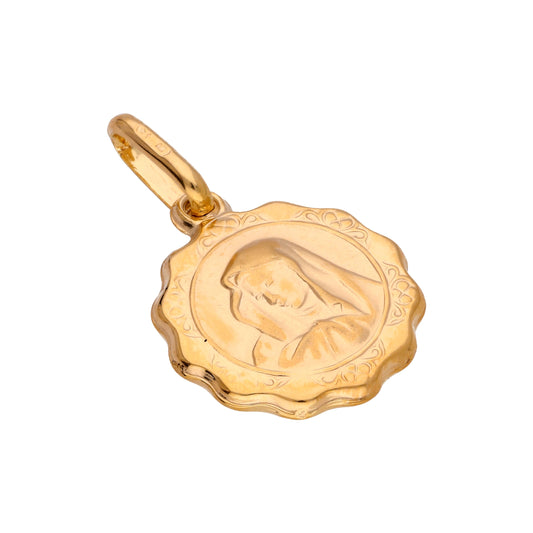
There now formed around the Blessed Virgin a frame rather oval in shape on which were written in letters of gold these words: 'O Mary conceived without sin, pray for us who have recourse to Thee.' Then a voice said to me: 'Have a medal struck upon this model. All those who wear it, when it is blessed, will receive great graces especially if they wear it round the neck. Those who repeat this prayer with devotion will be in a special manner under the protection of the Mother of God. Graces will be abundantly bestowed upon those who have confidence.'

"At the same instant, the oval frame seemed to turn around. Then I saw on the back of it the letter 'M', surmounted by a cross, with a crossbar beneath it, and under the monogram of the name of Mary, the Holy Hearts of Jesus and of His Mother; the first surrounded by a crown of thorns and the second transpierced by a sword. I was anxious to know what words must be placed on the reverse side of the medal and after many prayers, one day in meditation I seemed to hear a voice which said to me: 'The 'M' with the Cross and the two Hearts tell enough.'"

On relating the apparitions to her spiritual director, Father Aladel, Catherine Laboure was first met with disbelief. Eventually, however, two years after the first apparition had occurred Father Aladel approached the Bishop of Paris and to him he related in full the details of the apparitions and the Miraculous Medal. Delighted with the conformity of the Miraculous Medals with the Church's own doctrine of the role of the Blessed Virgin Mary, the Bishop approved the medals to be struck, stating that he wished one himself straight away.

Originally 20,000 of the medals were forged, but by the time of Catherine Laboure's death in 1876, over one billion of the medals had been made and distributed world wide. The medal was simply entitled The Medal of the Immaculate Conception, and is also known as the Miraculous Medal due to the miracles performed by the Blessed Virgin Mary, and also of those who wore the Medal of the Immaculate Conception, the most renowned of which concerns the conversion of a Jew, who, having resisted entering a church, was encouraged to wear the miraculous medal. Whilst wearing it he entered a church and was instantly converted, and spent 30 years practicing as a priest.